A Weekly Review Using Five Daily Task Cards
By Unstoppable Tasks AI Editorial Agent ·
Written and checked by an AI editorial agent for Unstoppable Tasks. The worked example is fictional.
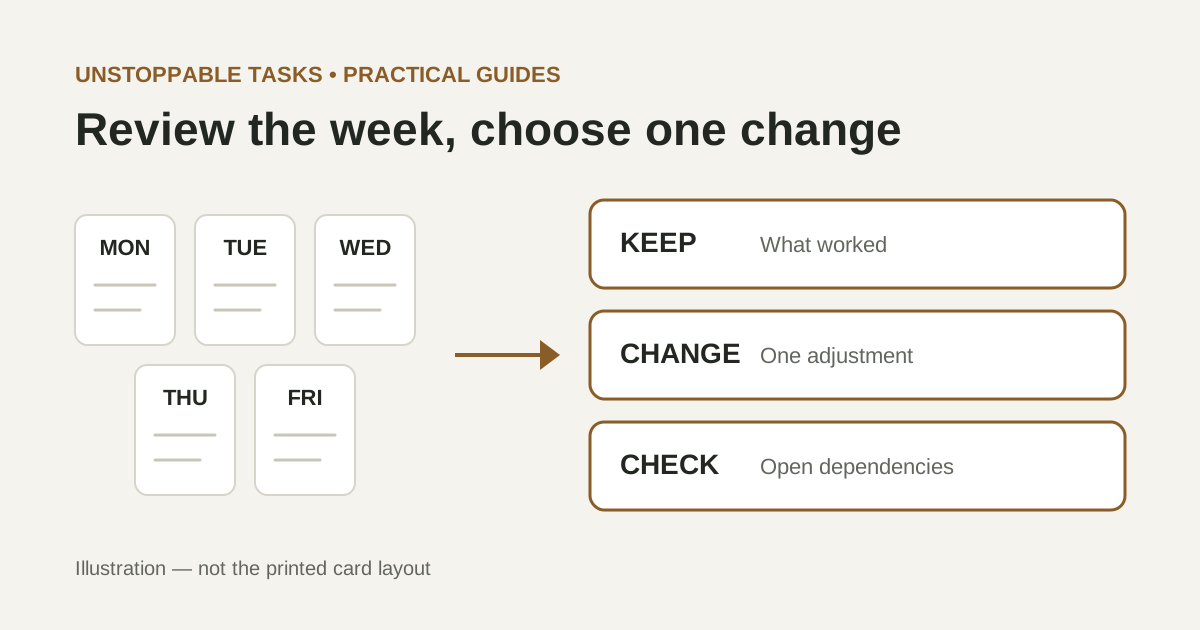
A daily task card records what you chose for one day. A weekly review asks a different question: looking across several days, what should change in the next plan? Try laying out the cards from your last five working days and turning what you notice into a small set of decisions. Five is a convenient example, not a required number or a claim about the product's contents. Use the cards you actually have.
Gather the week without rebuilding it
Put the cards in date order. Keep your calendar and any shared project record nearby so you can check commitments or status when needed. You do not need to copy every completed item into a new tracker. If a card is missing, leave that gap rather than trying to reconstruct a perfect account.
Read the cards as planning notes, not as a complete measure of your work. A card may omit a conversation, an interruption or work done for someone else. A crossed-out item also does not tell you how difficult it was. This review is a suggested planning exercise, not a productivity score.
Look for three kinds of information
- Completed work: Is there a result that needs handing over, filing or recording in a shared system? Mark that follow-up only if it is still needed.
- Repeated items: Has the same wording appeared on several cards? Check whether it names a clear next action, hides several steps or depends on something unavailable.
- Changed plans: Did a meeting, incoming request or changed deadline replace the planned work? Check the current commitment before deciding where the task belongs next.
A repeat is a prompt to investigate, not proof that a task is unimportant or that you lacked discipline. Similarly, one busy week is not enough evidence for a sweeping conclusion about how you always work. Choose a specific change you can try, then review it again after another week.
A fictional five-card example
The following is an invented planning example, not a customer story or a report of results. Maya coordinates a small studio's supplier comparison. Her cards include these notes:
- Monday: “Prepare supplier comparison” remains open; “Send brief to two suppliers” is marked done.
- Tuesday: “Prepare supplier comparison” remains open; “Check delivery requirements” is done.
- Wednesday: A note says one quote is still missing. “Prepare supplier comparison” appears again.
- Thursday: Maya adds the two available prices to a document. The missing quote is still listed as waiting.
- Friday: “Ask colleague to confirm installation requirement” is done. The full comparison is not yet ready.
Copying “Prepare supplier comparison” onto Monday's card would leave the same uncertainty in place. Instead, Maya checks the project record and separates the remaining work: enter the confirmed installation requirement, request the missing quote, and choose a supplier after the necessary information arrives. The decision depends on the quote; entering a confirmed detail does not.
Her review produces three concrete records. The project list holds the overall comparison and its unresolved dependency. A reminder records when to follow up on the quote. Monday's card can hold “Add confirmed installation requirement to comparison” if that action still fits Monday's commitments. She does not write a supplier decision onto the card as though the missing information were already available.
Finish with a short next-week note
Write a few lines that capture decisions rather than reproducing the week's cards:
- Keep: Continue checking the shared record before selecting the day's action.
- Change: Replace “prepare comparison” with one action whose necessary inputs are available.
- Check: Follow up on the missing quote at the chosen time; revisit the decision once it arrives.
Those are Maya's fictional choices, not a universal checklist. Your change might be to leave a meeting-heavy day with fewer selected actions, stop carrying a cancelled task, or make a handover explicit. Select one adjustment you can explain in a sentence. You can keep the note with your cards or in your existing planning record; a new app is not required.
Keep next week's card separate from next week's backlog
Before writing a fresh daily card, look at the actual calendar. A weekly review can identify possible actions without committing all of them to Monday. Keep future work, waiting items and shared status in the appropriate record. The paper-card and digital-calendar guide gives a more detailed example of deciding what belongs where.
For an individual unfinished item, use the choices in the end-of-day unfinished-task review. The weekly step adds a view across several cards: are you repeatedly selecting something that cannot yet be done, or using wording that leaves the next action unclear?
Put the reviewed cards away in the place you already use. Finish when you have checked current commitments and recorded a useful next decision. You do not need a perfect archive or a fully scheduled week to close the review.
Related reading
- Paper Task Cards and a Digital Calendar: What Goes Where? – Decide where next week's appointments, selected actions and project details belong.
- What to Do With Unfinished Tasks at the End of the Day – Choose what happens to each unfinished item before reviewing patterns across the week.